The Great Acceleration and Turbo-Acceleration: Growth, Critiques of Growth, Biodiversity Loss, Climate Change, Technological Singularity & the Anthropocene
Veröffentlicht am 22.06.2026
The Great Acceleration and Turbo-Acceleration: Growth, Critiques of Growth, Biodiversity Loss, Climate Change, Technological Singularity & the Anthropocene
Climate change, biodiversity loss, nuclear waste production, global pollution, desertification, rainforest destruction, overtourism, weapons proliferation, resource depletion ... the devastating impacts of human activity in the Anthropocene have many widely discussed individual causes. Yet behind these increasingly existential threats lies a common denominator, a primary driver that connects them all: the Great Acceleration. Despite its central importance, this phenomenon receives only limited attention in environmental debates and the media, largely because humans struggle to comprehend the implications of exponential growth and its consequences.
The term "Great Acceleration" describes the unprecedented demographic, economic, commercial, and above all exponential growth of human activities and their impacts on the Earth since the mid-20th century. It brought what we unquestioningly call prosperity today to the industrialized nations of the West—a relatively small portion of the world's population. However, this explosion of growth also brought environmental destruction, species extinction, climate disruption, and a massive overexploitation of planetary resources. Today, not only China, India, and Turkey but also the oligarchs of Silicon Valley have entered a phase of explosive expansion, transforming this acceleration into a form of turbo-acceleration. The Great Acceleration and Exponential Growth
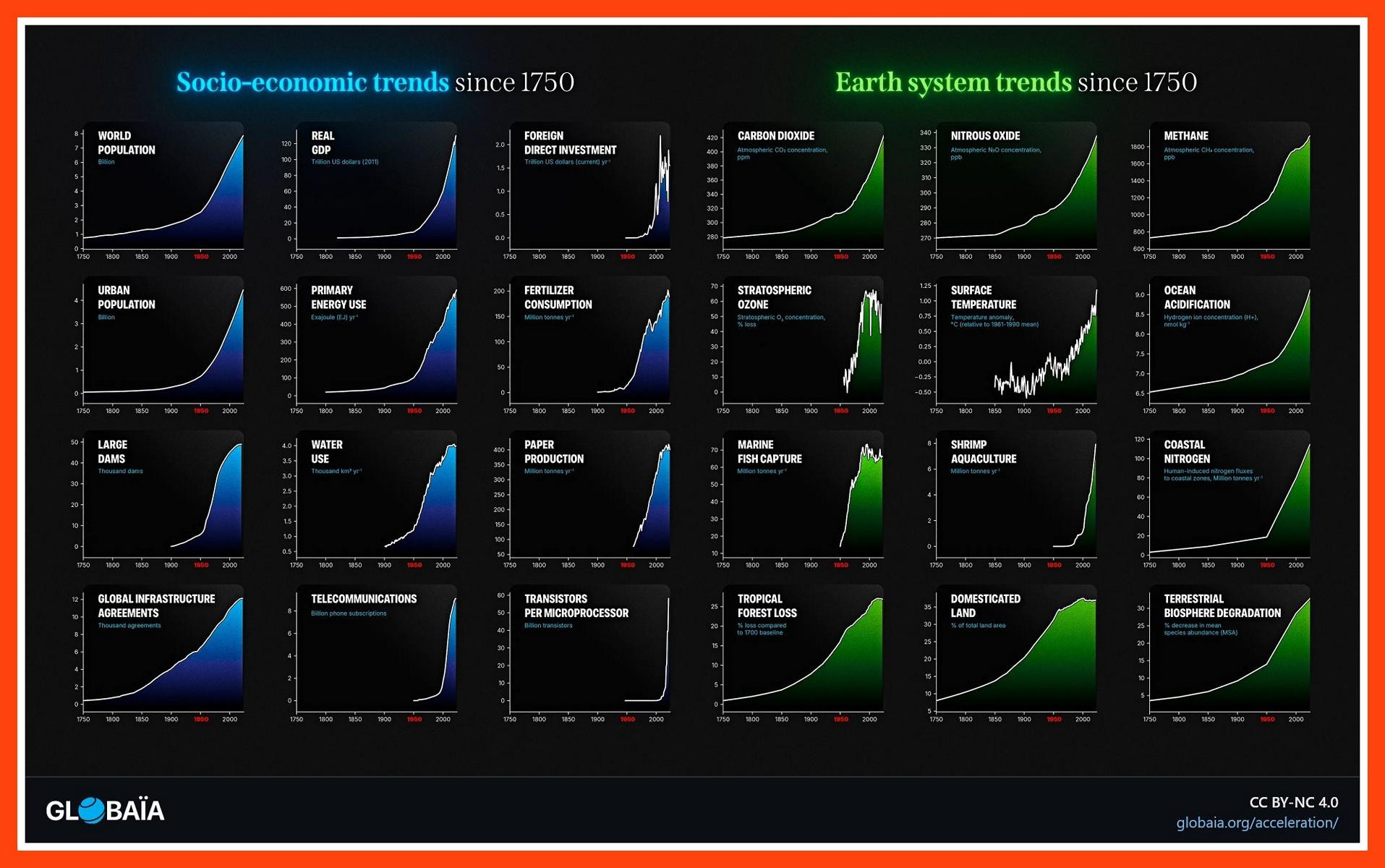
During the Great Acceleration, remarkable socioeconomic and Earth system trends became visible. Economic output, energy consumption, fertilizer use, nuclear waste production, water consumption, greenhouse gas emissions, ocean acidification, marine fisheries exploitation, species extinction, world population, urbanization, tropical forest loss, and plastic production have all grown exponentially, to name only a few examples.
"The global population increased from approximately 2.5 billion in 1950 to 8.3 billion in 2026, while the share of people living in cities rose from 29% in 1950 to around 56% in 2021. By 2050, urban residents are expected to account for 68% of the world's population. Global GDP increased from US$9 trillion in 1950 to more than US$105.7 trillion in 2023. Parallel to these trends, changes in the Earth system have accelerated: atmospheric CO₂ concentrations rose from 310 ppm in 1950 to more than 426.5 ppm in 2026. Global average temperatures have increased by approximately 1.6°C since the pre-industrial era, while the rate of species extinction is estimated to be between 100 and 1,000 times the natural background rate. In addition, plastic production has surged from two million tonnes in 1950 to more than 414 million tonnes in 2023, and the global use of nitrogen and phosphorus fertilizers has increased dramatically, contributing to water pollution and eutrophication." Sources: United Nations, World Bank
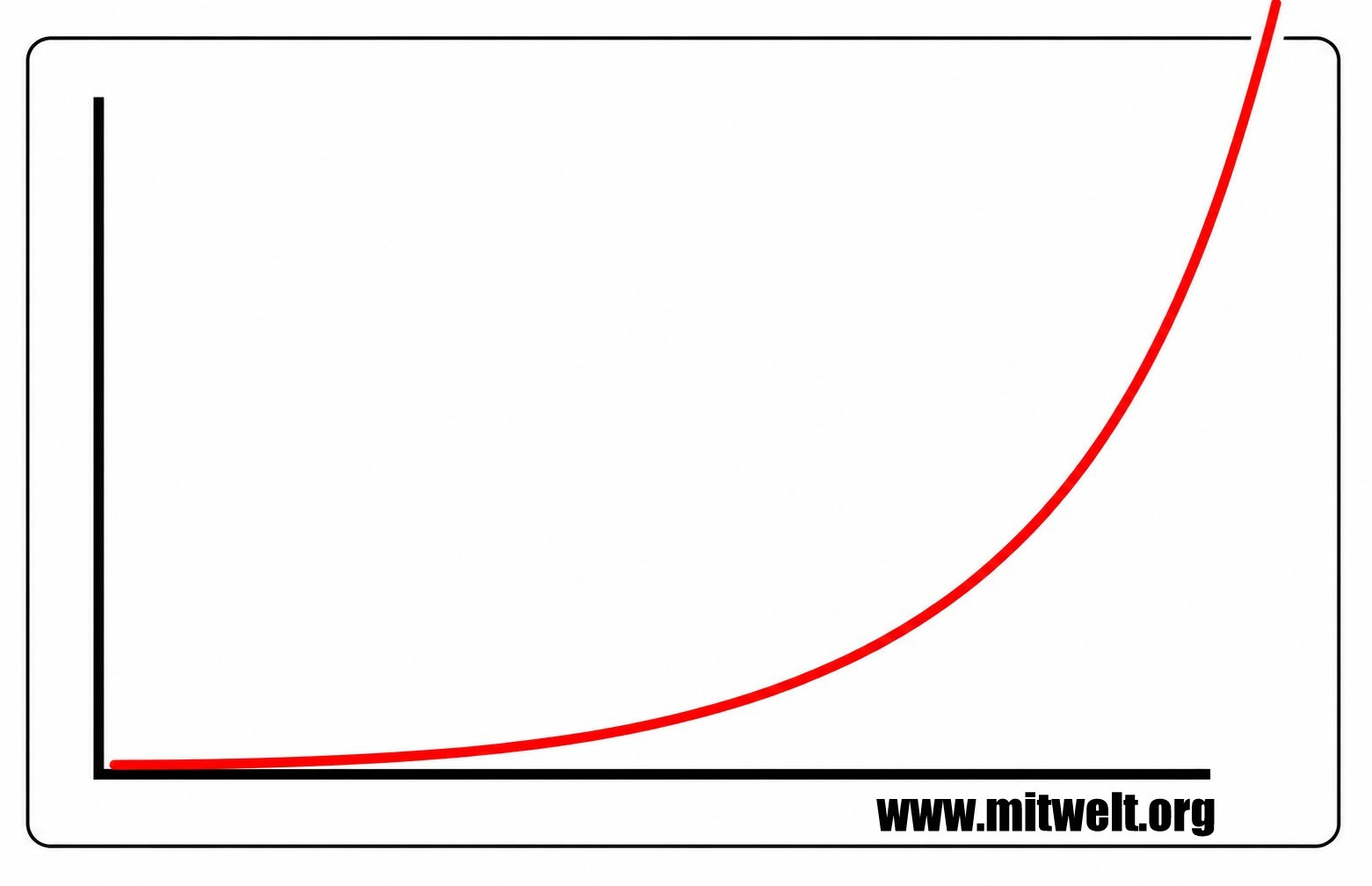
The Great Acceleration and Exponential Growth Imagine that 300 years ago you had invested one euro (which did not yet exist at the time) at an annual interest rate of 3%. For many years, very little would have seemed to happen. Yet by around 1950, the accumulated capital would have begun to grow noticeably through compound interest. Starting from €1 in 1730, the investment would have grown to approximately €7,095 by 2030 and to around €56,113 by 2100. Now replace the term "euro" with economic output, energy consumption, CO₂ emissions, fertilizer use, nuclear waste production, water consumption, greenhouse gases, ocean acidification, marine fisheries exploitation, global population, tropical forest loss, or plastic production ... Exponential Growth as the Driver of the Great Acceleration
For centuries—arguably even millennia—human growth was roughly linear and was only occasionally interrupted by wars. After 1950, however, growth exploded, particularly in the industrialized nations of the West. By that point, accumulated capital and productive capacity had crossed a critical threshold that enabled exponential expansion.
Anything growing at 3% doubles approximately every 23 years; at 5%, it doubles in just 14 years. A quantity growing exponentially increases a thousandfold after roughly ten doubling periods. Permanent exponential growth within a finite system is impossible and ultimately leads to self-destruction. Human beings simply do not grasp the consequences of sustained exponential growth. We live in a system that functions only if it continues to grow—and thereby inevitably undermines itself. Belief in unlimited growth on a finite planet is one of the greatest delusions of our time.
Crisis Without Growth / Destruction Through Growth Many Western countries are currently experiencing a growth crisis. This has contributed to profound social and political tensions, not only in the United States but also in Germany. The most effective solution to the social consequences of this crisis would be greater fairness and a more equitable distribution of the productivity gains achieved over recent decades.
For decades, wealthy nations promised the countries of the Global South that, with sufficient hard work, people in China and India would one day be able to "afford a Mercedes" as well. Today, the threshold of the Great Acceleration has been crossed, and productivity in many countries of the Global South has increased to the point where they can manufacture competitive cars and other products themselves. Throughout history, such competitive conflicts have often been "resolved" through war. In an age of weapons of mass destruction, that would be a disastrous option.
Greed and the Religion of Growth: A Central Obstacle to a Good Life "A single billionaire is as damaging to the climate as one million people," according to an Oxfam study. Millionaires aspire to become billionaires, high earners want to become millionaires, the poor in Germany want to become high earners, and much of the rest of the world would like to live as extravagantly as we do. Even with advanced green technologies, this trajectory cannot end well.
Global species extinction, climate change, nuclear waste production, global pollution, environmental degradation, and growing social inequality are symptoms of a deeper disease: the compulsion for growth.
Around 10,000 years ago, only five to ten million people lived on Earth. Today, more than 8.3 billion people inhabit the planet, many aspiring to the levels of consumption enjoyed in affluent societies. It is therefore unsurprising that this explosive expansion has severe consequences for other forms of life. Few now dispute that the Earth is undergoing a mass extinction event comparable in scale to the one that eliminated the dinosaurs 66 million years ago.
We live in a system of globalized greed that appears to function only through perpetual growth, while paradoxically leaving people increasingly dissatisfied. In an era of unleashed global greed, both society and political leaders struggle to imagine the consequences of exponential growth. Critiques of growth, however, must not be used to justify the current extreme inequalities of the world. Many countries in the Global South still require intelligent, environmentally sustainable forms of catch-up development.
Positive and Broken Growth Curves In a few areas—such as DDT, smog, asbestos, CFCs, and sulfur dioxide emissions—the environmental movement has succeeded in slowing some of the most destructive trends. These are encouraging achievements, but they remain limited exceptions. One significant success story has been the development of renewable energy technologies. Solar and wind power have long become cheaper than electricity generated from coal, gas, or nuclear power. Nevertheless, even renewable energy can contribute to further acceleration if underlying patterns of growth remain unchanged. A sign of hope is emerging from an unexpectedly technical quarter: the "mobile phone dip." Since 2008, birth rates in almost all 38 OECD industrialized nations have either stagnated or steadily declined. By now, birth rates in more than half of all countries worldwide have fallen below the replacement level of 2.1 children per woman. The "mobile phone dip" follows the "Pill dip." The smartphone has fundamentally altered human social interaction. While this shift brings problems and is portrayed in the media as a catastrophe, it also acts as a brake on the consequences of "super-acceleration."
Trump, Musk, Milei, Thiel ... The Great Accelerators Advocates of growth, greed, and expansion today include market-radical and right-libertarian figures such as Trump, Musk, Milei, and Thiel, along with organized fossil-fuel interests. They promote a vision of unrestrained capitalism liberated from ecological limits, democratic constraints, and social responsibility.
Through libertarian ideologies, space tourism, cryptocurrencies, energy-intensive data centers, and transhumanist ambitions, these actors accelerate destructive processes. Elon Musk's grandiose growth ambitions are merely one prominent example. Once again, proponents of unlimited expansion place their hopes in future technological "miracle solutions."
Technological Singularity and the Great Acceleration The potential effects of the anticipated technological singularity on the Great Acceleration are impossible to predict. The technological singularity refers to a hypothetical point at which artificial intelligence surpasses human intelligence, rapidly improves itself, and triggers an uncontrollable acceleration of technological progress and growth.
Once an AI becomes capable of enhancing its own intelligence, recursive self-improvement could occur, with each generation becoming more intelligent than the last. Beyond this threshold, change could become so rapid and profound that the future would become fundamentally unpredictable for humanity. Rethinking Progress and Prosperity
If we wish to halt climate change and the ongoing extinction of an estimated 130 to 150 animal and plant species every day, we must ultimately transform the current growth-driven system founded on greed and ecological destruction. (This is easier said than done.)
We already possess the knowledge and the sustainable technologies needed to provide all people with a good quality of life while using far fewer resources, less energy, and less labor. Our task is to shape progress, technology, and the future in ways that are humane, equitable, and globally just. We must encourage forms of development that emphasize moderation and resilience while challenging destructive trajectories.
The concepts of prosperity and the "good life" must be fundamentally redefined. An environmental movement that confines itself to narrow niche issues risks overlooking the systemic causes of today's crises.
As Mahatma Gandhi once observed: "The world has enough for everyone's needs, but not for everyone's greed."
Axel Mayer, Mitwelt Stiftung Oberrhein
This text has been translated by a machine and has not been checked
Source: globaia.org/acceleration
The Great Acceleration and Turbo-Acceleration: Growth, Critiques of Growth, Biodiversity Loss, Climate Change, Technological Singularity & the Anthropocene